Gift ideas for gifting to someone with chronic illness.

Gift ideas for gifting to someone with chronic illness.

I wanted to put together a list ideas for gifting to those with chronic illness.  I know that Christmas can be a tough time for people with chronic illness.  However, I always love when someone buys me something that they’ve put thought and understanding into, something that is meant to make life with chronic illness more manageable or comfortable.  So if you know someone with chronic illness; here are my top gift ideas.

  1. Electric blanket or throw – A lot of people with chronic illness struggle with temperature control.  Since developing M.E I’ve really struggled to regulate my temperature and I find it really hard to warm up or cool down.  I suffer with constant icy skin and it can make muscle and joint pain worse.  I never thought I’d be someone who liked electric blankets, they seem dated…but I wouldn’t be without mine.  It’s one of the only ways I can warm myself up when I’m cold.  I use a full mattress covering underblanket that goes on your mattress and beneath your bottom sheet.  It warms the whole bed and I can put it on a few minutes before getting into bed.  It works really quickly and I don’t even need to have it on for half an hour before I’m feeling toasty and comfortable.  It’s a real life saver in winter.  Heated throws are a good option too, especially if you’re relaxing on the sofa and just need an extra boost of warmth. 
  2. Hot Drinks Maker – I have a coffee/hot drink machine that has made it so much easier to prepare hot drinks.   A lot of people don’t realise how just making a hot drink can be hard but in fatigue and pain disorders, it can be difficult.  I often can’t manage the energy needed to just stand and wait for the kettle to boil.  I also really struggle with muscle weakness so I struggle to pick up a kettle and pour it safely.  I like hot drink makers because it just involves putting a pod in the tray and putting a mug under the nozzle.  The water storage isn’t huge so I can fill it easily and it makes a drink in 30 seconds.  When my energy is low and I just need a hot drink quickly, it’s a huge relief to be able to make one easily and without much effort.  It’s those little things that allow me to be more independent and not rely on someone else to get me something.
  3. Pyjamas/ Lounge clothes – A secondary issue I experience with my M.E is allodynia which means I experience pain when wearing tight or restrictive clothing.  I know a lot of people with chronic illness who suffer with sensitive skin and pain to the touch.  So I find myself mostly wearing pyjamas or loungewear because it’s elasticated and it’s loose so it doesn’t set off my pain response.  I genuinely enjoy getting pyjamas for Christmas because I wear them so much and when you have chronic pain; any measure of comfort that makes you feel a bit more cosy or comfortable is welcome.  A huge hit with me is comfort bras because underwire really triggers my allodynia so sports bras and comfort bras that just have some padding but no underwire or clasps are another big relief.
  4. Automatic pet feeders – Pets can be a huge emotional crutch for people with chronic illness.  Chronic illness is very isolating and lonely so I know pets are an important level of support for chronic illness sufferers.  I couldn’t be without my pets and I’m lucky to live with family who take up a lot of the care responsibilities when I can’t.  But for people who don’t always have that support network, gadgets that make keeping a pet easier could be a really big help.  Automatic pet feeders are a great option because fatigue disorders make remembering things challenging at times, I often have to set alarms to remind myself of chores that need doing.  M.E in particular is a fluctuating condition which means you might be able to do something one day and then not be able to get out of bed the next.  Automatic pet feeders mean a chore is essentially done for you, saving you energy when you don’t have it and covering you when you are struggling to function.  Anything that helps someone with chronic illness live a bit more independently is a good gift in my opinion.  There are lots of pet feeders out there, with different storage capacities and timing slots so pick whatever works best for you or the person it’s for.
  5. EReaders – Chronic illness means spending a lot of time in bed or resting, it can be maddening not being able to do what you want to do.  I’m a massive bookworm and reading really helps me escape my daily life and that escapism is a huge mood boost.  EReaders are one of my favourite inventions because I can have all my books in one place, the device itself isn’t as bulky as an actual book and I don’t have to turn pages manually or hold a book open (which my muscle pain and weakness can make difficult).  Most EReaders allow you to enlarge text and change light options on the screen so it’s easier on the eyes and less likely to cause fatigue.  I prefer the paper-like screens on my EReaders because they aren’t too bright and it doesn’t feel like looking at a screen.  You can also do things like bookmark multiple pages, highlight quotes you like and it saves your progress in multiple books so you can switch between books depending on your mood.  It’s a really useful little gadget.
  6. Takeaway food gift cards –  A lot of the big food delivery companies do gift cards now which I think are a great gift option for someone with chronic illness.  There’s nothing worse than not having the energy to cook for yourself, feeling hungry but not physically being able to make yourself a hot meal.  Someone who’s experiencing a pain or fatigue flare-up may be physically unable to make themself something to eat.  I know I’ve skipped meals because I simply haven’t had the energy or capacity to make anything for myself and it’s miserable.  Takeaways can be a real life-saver for someone suffering with chronic illness.  A lot of people see takeaways as luxury but when you’re too ill to cook for yourself, they are more essential.  I know a lot of people who are disabled or can’t work because of illness struggle financially so ordering takeaways isn’t always an option.  So these type of paid gift cards make a really useful gift option for someone with chronic illness.
  7. Lap trays/ bed desks – Another useful and practical idea for someone with a chronic illness who may spend a lot of time confined to a bed or sofa.  It’s really hard to do anything from your bed without one of these.  When I was studying from my bed, I found it hard to use notebooks or computers comfortably.  You need a flat surface do a lot  of hobbies from bed.  Lap trays and fold up desks are really useful in this situation.  I used a small lap desk that was padded underneath so it was comfortable to use and not too big.  I also use the fold up tables that just go over your legs which can be really useful to avoid stooping over and getting back/neckache when using a computer or writing. 
  8. V pillows, lumbar cushions etc – Chronic pain can make sitting or laying in one position for too long impossible.  Supportive pillows can be a really useful thing for someone with chronic pain.  I couldn’t be without a v-pillow in my bed because I suffer with awful back pain; the way it can curve around my back and provide extra support helps my pain levels a lot.  I find lumbar cushions useful when I’m relaxing on the sofa because I often need that extra back support to be comfortable.  There are so many cushions and support pillows out there and they do make a really big difference to someone with chronic pain, so they make a thoughtful gift.  Just try and find what works best for the person you’re buying for, where their pain may be worse and what cushion would best assist or provide support in this area.
  9. Window bird feeders – Again, being confined to bed can be very boring and it can be depressing just seeing the same four walls for long periods of time.  I bought myself a window bird box when I was struggling with a flare up and I was sick of being stuck inside all the time.  It was just a square transparent box stuck to my window but it brightened my days up so much when birds stopped by.  I’m a huge animal and wildlife lover and I really miss those things when I’m bed or housebound for long periods.  Seeing these birds visiting my window everyday just lifted my mood during those times and let me feel closer to nature despite being stuck inside.  Birds are excellent and finding new food sources and telling all their friends so I had small flocks visiting in no time. 
  10. Streaming channel subscription – There are so many great streaming channels out there now and a subscription makes a great gift for someone with chronic illness who may be housebound.  Being housebound because of illness can be so miserable and lonely, it can really impact mental health.  I think any distraction is welcome in this case, anything that means that person isn’t just sitting with only their thoughts to keep them company.  Streaming services give someone with chronic illness a way to escape and think about something else for a while.  A lot of people subscribe to these channels and it’s an entertainment must have these days, but for someone whose stuck inside feeling ill, it’s a window to somewhere else.  That’s why a subscription to any of these channels is a fun gift option for anyone, but particularly for someone with a chronic illness who needs that entertainment and escapism.  

I hope this list inspires you if you’re struggling to buy for someone with chronic illness.  I think any gift that makes life a little easier or comfortable for a chronic illness sufferer is a great gift.  Just think about what they struggle with and how that struggle might be made a little less exhausting or painful for them.  I love practical gifts that allow me to be a bit more independent or make simple chores less energy draining. 
My tips for managing Christmas with M.E.

My tips for managing Christmas with M.E.

All the Christmas adverts have hit and the shops are full of festive food and decorations once again.  The festive period is an exciting one for many; a time to plan parties, buy gifts, overindulge with food, spend time with family and generally just be in good spirits.  At the same time, it can be a stressful time; especially for those struggling with chronic illness or disability.  I know that the festive period is one where I always feel my fatigue the worst, and it’s a time of year where everything is very overstimulating and exhausting.  So I thought I’d share a few of the ways I make Christmas a bit more manageable.

Gifts

When you have a lot of people to buy for at Christmas, it can be an overwhelming prospect.  Especially with fatigue and brain fog; I can decide on particular gifts and then forget what I’ve decided on, I buy gifts and then forget I’ve bought them, I wrap things and then forget what I’ve wrapped and for who.  So I like to plan and keep record of everything I buy and for who.  I start by making a list of everyone I need to buy for (I usually make this list early in October so it gives me time to think of gift ideas) and then when I decide on a gift or have a gift idea, I add it next to a name…then tick it off when I’ve bought it.  Then, when it’s wrapped I note that on the list too. An alternative to individually wrapping gifts is to use gift bags, no wrapping needed, just add the gift and seal it or add some coloured tissue paper to make it look a bit more festive. It’s a nice way to gift things if you prefer not wrapping; it takes less time and energy but still looks good.  I always put festive sticky labels on my gifts straight after being wrapped so it says clearly who it’s for.  I’ve been in a situation where I waited to label everything and then had to unwrap it all to remember which gift was which; so I label everything immediately now.  I always keep the list of names and gifts until after Christmas too so that if people thank me, I know what they are thanking me for.  There’s nothing worse than being thanked for a gift and not remembering what you gave someone and it may seem like a silly thing to forget, but brain fog isn’t logical.

Socialising

Christmas tends to involve a lot more socialising than I usually do.  Getting gifts to everyone, attending Christmas events, seeing family, shopping…it’s a lot of mingling and that can take a toll on my M.E.  As a rule, I tend to try and arrange a day with one person then make sure that there are at least a couple of days between I arrange to meet someone else.  This just ensures I’ve got a rest day in between to recover my energy levels.  I’m lucky that I have understanding friends and family who don’t mind visiting me at home.  I find that meeting people in busy town centres, especially at Christmas is too overwhelming for me and I can’t cope with it for very long.  So I either arrange meetings at home and order some nice food in, or I arrange to meet somewhere I know is quiet, away from crowds.  It makes a big difference in my energy levels. 

I spend a lot of time with family and I enjoy it when we’re all together, it can be tough at Christmas though.  When you’ve got a lot of people all in a small house, children running around excited and high on sugar, a meal being cooked, gifts being given and opened.  It’s something I love but it drains my energy levels very quickly.  When there’s so much going on around me, my fatigue can spike and I find it hard to keep up with everything.  There are a couple of things I do to make this experience a little bit easier to cope with.  Turning background noise off for a bit can help me; when lots of people are speaking and children are playing; turning off any music or tv in the background just means it’s not too much stimulation.  When I’m fatigued, a lot of different noise sources can make it hard for me to follow conversations and interact with people normally.  So I try and turn music or the tv off for periods of time when family are around, it’s just less of an assault on the ears.  I try and take ten minutes out in a quiet room if I’m feeling particularly overwhelmed, just taking those ten minutes regularly throughout the day can refresh me a little bit and let me decompress.  I also help to try and not do everything all at once; take an hour to open gifts and give gifts, take half an hour to clean up all the wrapping and packaging, take a couple of hours for eating dinner etc.  Splitting it into periods of just focussing on one thing means it’s not all going on at once.  Stay hydrated, although Christmas is all about the food and drink, it can be easy to forget simple things when a lot is going on around you.  I always make sure I fill a huge glass or bottle with water or juice before people arrive and leave it somewhere nearby.  Again, I’m lucky to have a family who accommodates this and understands how exhausting overstimulation can be and how my energy levels can be impacted.

Cooking

I’m going to start off here by saying that I don’t cook Christmas dinner, that’s always another family member.  My fatigue and brain fog can make cooking extremely difficult for me.  But, I know other people who have M.E may be the designated cook on Christmas day and I applaud you because I understand the challenge of cooking with M.E.  My advice is to plan everything! Schedule everything the night before and set as many alarms as you need to.  Write it all down; ingredients, cooking equipment, times to put things in the oven, the lengths of time things take to cook etc.  You can’t be too prepared.  If there are things you can prepare the day before and leave in the fridge then that might make it less of a hassle on Christmas day.  Don’t be embarrassed to set hundreds of alarms on your phone for when things need putting in the oven, checking on or taking out the oven.  My main advice is to not overstress about getting everything perfect.  There’s so much pressure on getting the food at Christmas perfect, it can be intimidating.  Personally, the Christmas dinners I’ve enjoyed the most are the ones where something went wrong; the cat eating the pigs-in-blankets off the counter, completely forgetting to cook the yorkshire puddings, forgetting to turn the oven on and realising an hour later….it’s all comical memories and I think that’s more important than perfection!

Wrapping/Decorating

Wrapping presents at Christmas is one thing I put off for too long.  I always end up on the floor surrounded by tape, paper and labels with a heap of presents I’ve left until the last minute to wrap.  So my advice is, break it up!  Wrap a few everyday or every second day, keep a record of what’s being wrapped and label everything.  Find a comfortable place to wrap gifts, I always end up on the floor and then I’m stiff and achy after 15 minutes.  The same advice applies to decorating, do it in sections or split it up somehow.  Focus on just one room for the day or just do the tree, then do another section another day or after an hours rest.  It can be tempting to put it all up in one go and spend the whole day hanging and putting things out but I find this triggers my post-exertional malaise and I suffer for it worse the next couple of days.  So splitting it up into more manageable sections can negate that.

Be Honest

My last tip for managing Christmas with M.E or another chronic illness or disability is to be honest with people about how this festive period affects you and your illness.  It’s always easier to hide how challenging we find this time of year, how overwhelming it can be and how it can have an impact on our health.  But, people won’t understand unless you share this with them.  It can be embarrassing to admit you need a little bit more help or assistance, or that you’re not coping with something, but it shouldn’t be something shameful or awkward.  It’s okay to rearrange or decline social occasions if you think it’s going to negatively impact your health, it’s okay to ask for time alone if you’re feeling overwhelmed and it’s okay to say you’re struggling and need some help.  Christmas should be a time for understanding and acceptance, for being around the people you love without judgement.  It’s important to be kind to yourself at this time of year and not put yourself under too much pressure to be perfect. 

M.E and Winter Illnesses

M.E and Winter Illnesses

If the covid pandemic taught us anything, it’s how dangerous germs can be; how easily they can be passed on and left on surfaces and how quickly they can spread.  I hoped that this would be a fact that stayed with people after the pandemic and that, people would think more carefully about how they interact with the world when fighting a virus.  Unfortunately I think it’s something that the majority of society has pushed to the back of their mind, ‘now the pandemic is over and done with, what’s the big deal?’  Unfortunately though, covid isn’t the only virus out there that can make people really unwell and there are still people out there with compromised immune systems and those struggling with a chronic illness like I am. 

Every year, that inevitable time of year comes when everyone seems to fall ill with a cold or similar winter virus and I dread it.  I love autumn and winter but winter illnesses can make these seasons risky for me.  My M.E was triggered by a virus 8 years ago, which highlights the fact that although viral illnesses may be short term; they can have real long term consequences on the body.  I used to be a fairly healthy person, I’d catch the common cold and get over it quickly and life would go on regardless.  I miss my body’s ability to fight off viruses so effortlessly and quickly.  Now, a simple cold can be a real detriment to my health, it can cause a full relapse of my chronic illness, it can undo all the work I’ve done to manage my M.E.  It doesn’t matter how much progress I’ve made with my illness because a simple virus can eradicate it all and leave me back at square one, possibly bedbound and unable to live my life properly.

One of the things during the pandemic which I didn’t find novel was the question “any fevers, coughs or runny noses?” when trying to book an appointment somewhere. I’ve asked family and friends a similar question every winter since I became ill with M.E because when living with a chronic illness that makes fighting off viruses and other illness difficult; it’s all about minimising the risk of contracting anything.  I’m sure some family and friends have thought me paranoid or dramatic but I have to do what I can to avoid winter viruses.  I know it’s pretty inevitable that I’ll catch something over winter and more than once, that’s life.  But, I get really frustrated when someone who is evidently unwell takes no precautions to protect other people who may be less overall healthy than they are.  I’m not sure when people became so selfish, where did a thought for others stop entering people’s minds?  Covid should have taught us how easily it is to spread a virus, how badly it can impact some people.  It’s a lesson that I hoped would stay with more people, that would encourage people to think about others, to be more aware of germs and the ways illnesses are spread. 

My blog post today is motivated by an experience at my local supermarket last week, an experience which really annoyed me and made me want to just hibernate away all winter.  Within minutes of walking into the shop I witnessed a woman blowing her nose and coughing.  A fairly normal sight for the colder months but this woman was making no effort to cough into her hands, or sneeze into a tissue.  Instead she was picking up food, coughing all over it then placing it back on the shelf.  She did it dozens of times and she didn’t even seem aware of the fact she was spreading hundreds or thousands of germs over these food items then just putting them back for others to potentially touch. It’s that ignorance that frustrates me because there was clearly no awareness of what she was doing and therefore no attempt to minimise the risk to others. The worrying thing was, I saw a few people coughing and sneezing without an attempt to cover their mouth or nose, there were a few customers who seemed to have a cold or similar illness but not be worried about spreading it on to others instore.  I completely understand that the majority of people have to get on with life when they have a cold or virus, if you’ve got to go out to a public place then you’re entitled to do that.  I just don’t understand why it’s so difficult to carry a mask if you know you are unwell and it may be contagious, we know how important mask wearing was in preventing the spread of covid.  It’s a simple thing to just put a mask on and protect others, it’s a simple way to limit the amount of germs you are spreading when ill.  Even coughing into your hands or sneezing into a tissue is preferred over freely coughing and sneezing into the air; that’s something I was taught when I was a child.  My Mum manages a shop and it’s shocking how many customers come in and when asked how they are, reply; “Oh I’ve got this horrible virus, I’ve been really ill” or variants of it.  It’s scary to me, how many people have no issue going out and potentially passing on their viral illness to someone vulnerable.  I’m not saying that someone with a virus should lock themselves away, I’m saying that the pandemic taught us so many ways of limiting the spread of germs and everyone seems to have completely forgotten them.  Social distancing, mask wearing, carrying sanitizer, coughing and sneezing into a tissue and disposing of it afterwards.  All these things are simple but people just aren’t doing them.

I don’t think healthy people understand how scary a simple virus is to someone with a chronic illness or poor immune system.  Chronic illnesses like M.E are about daily management, struggling with chronic symptoms that affect every aspect of life.  I have to fight so hard to be a relatively normal, functional being and manage all my symptoms and limit the chance of flaring them up.  So adding a virus to that struggle makes management almost impossible and I’m often left bedbound for weeks, relying on other people to care for me.  I’m never sure how badly a virus will effect me afterwards; will I return to my previous level of functionality? or will I backslide and be unable to do things I’d previously started to manage.  Will it cause my M.E to completely relapse and revert to when I was at my worst, how long will this last? A simple winter virus that most people will recover from in a week, or not even know they have; has a huge impact on my life and health.  I just wish more people understood that, I wish more people considered this when going out with a viral illness that could be passed on to someone more vulnerable. 

It’s one of the reasons that people with severe chronic illness feel so isolated; because to keep our health stable, we have to isolate ourselves.  If people can’t take simple measures to restrict how they spread germs and viral illnesses then what choice do we have; but to avoid social contact. 

I guess my advice for chronic illness sufferers this winter is; it’s okay to be selfish if you’re doing it to protect yourself.  By this, I mean, don’t be afraid to ask people you’re meeting with if they have any cold or viral symptoms, don’t be afraid to cancel social appointments if you believe someone there may have a virus.  Don’t be afraid to tell you’re loved ones how detrimental a simple illness like the common cold can be to you.  People may be judgemental and say you’re a hypochondriac, but the people who genuinely care about you will understand and want to keep you healthy this winter.  More importantly, if you’ve got to go out into public places then do what you can to protect yourself; carry sanitizer, carry a mask, distance yourself from people you see coughing or sneezing, wash your hands frequently and try to limit how many public surfaces you touch. Be safe and do what you can to prevent the spread of winter illnesses, because a lot of people are ignorant of the impact these simple illnesses can have on someone with a low immune system or a chronic illness.

(Just a note to say, excuse any spelling or grammatical errors in this post. I am actually currently suffering with a cold and the fatigue and brain fog are currently awful.)

My Favourite Quotes, living with Chronic Illness.

My Favourite Quotes, living with Chronic Illness.

It’s hard to feel hopeful and optimistic about life when your living with a chronic illness. The very nature of a chronic illness is that it’s ‘chronic’. It doesn’t suddenly go away. My experience with M.E has been a constant struggle against pain and fatigue; a balancing act with energy levels and living life. Drowning in all that exhaustion and malaise can be so deflating and it can be hard to stay positive and hopeful. The feeling that the struggle is pointless follows me around like a dark cloud and at times it’s hard to see past that hopelessness. But, I’ve always believed that words hold more power than people think; words connect people and feeling. When I read something written or spoken that sums up my feelings, it makes me feel less alone; that someone out there has felt the same way at some point in their life too. So I wanted to compile a list of quotes which have resonated with me; as a person living with chronic illness. These quotes have given me comfort and hope when things have seemed bleak. They remind me that there are others out there fighting the same battle, feeling the same way; but continuing on despite the struggle. They remind me that there is hope and reason to carry on and live life, despite the limitations and obstacles that chronic illness puts infront of me.


⦁ “The question is not how to get cured, but how to live” – Joseph Conrad


⦁ “Often the pain that makes us feel most stuck is not our suffering; it is experiencing distress in the presence of people who expect us to get better faster than we can.” – K.J. Ramsey


⦁ “Promise me you’ll always remember: You’re braver than you believe and stronger than you seem and smarter than you think.” – A. A. Milne


⦁ When you are faced with an on-going medical catastrophe, it forces you to take notice of the little things that you may have overlooked when you were dazzled with good health. You recognize that the little moments are not so little. The appreciation of accumulated small little moments can create a happier life.” – Karen Duffy


⦁ “I can be changed by what happens to me. But I refuse to be reduced by it.” – Maya Angelou


⦁ “It got worse still as time went on because people did not sympathize with you any more. They couldn’t do enough for you at first, and that helped, and then they got bored with your troubles. But your troubles went on just the same and you had to bear them alone.” – Elizabeth Goudge


⦁ “As we sat at the table, acting like the drink wasn’t sour and pulpy, we got to talking about how her illness had come to affect her life. She explained to me that her energy reserves were like that glass of yellow juice. Every action of daily life—getting out of bed, bathing, dressing, doing research—siphoned juice away. Once the glass was empty, no matter how much she had left she needed to do or how much she’d hoped to get done, her body needed to rest. To refill the glass. If she tried to push beyond that, it could knock her out for days. Even weeks.” – Jessica S. Olson


⦁ “Those of us with chronic pain have something unique to offer, not in spite of our pain, but because of it. It’s okay to grieve the losses of chronic illness. It’s okay to be broken; everyone is in some way. Just because we’re unfixable doesn’t mean we’re worthless.” – Allison Alexander


⦁ “It’s my experience that people are a lot more sympathetic if they can see you hurting, and for the millionth time in my life I wish for measles or smallpox or some other easily understood disease just to make it easier on me and also on them.” – Jennifer Niven


⦁ “Remember to look up at the stars and not down at your feet. Try to make sense of what you see and wonder about what makes the universe exist. Be curious. And however difficult life may seem, there is always something you can do and succeed at. It matters that you don’t just give up.” – Stephen Hawking


⦁ “Never give up. It’s like breathing – once you quit, your flame dies letting total darkness extinguish every last gasp of hope. You can’t do that. You must continue taking in even the shallowest of breaths, continue putting forth even the smallest of efforts to sustain your dreams. Don’t ever, ever, ever give up.”- Richelle E. Goodrich


⦁ “The best way to treat obstacles is to use them as stepping-stones. Laugh at them, tread on them, and let them lead you to something better.” – Enid Blyton

Feel free to comment any of your favourite/inspirational quotes!

What’s in a name?

What’s in a name?

Myalgic Encephalomyelitis (M.E), Chronic Fatigue Syndrome (CFS), Yuppie Flu, Post-Viral Syndrome; all names for the same condition.  So why do I use M.E? 

The main reason I use M.E to refer to my illness, is probably one of the most common reasons; and that is because it doesn’t just refer to one symptom of the illness (Fatigue), it doesn’t describe it as a flu (short term illness) and it doesn’t imply you can only get it after already being unwell (Post-Viral Syndrome).  Although Myalgic Encephalomyelitis is a mouthful, it doesn’t just refer to a single symptom or indicate a single cause.  The majority of people I speak to, recognise my condition as CFS, even health professionals; it’s difficult for me when I hear this name because it doesn’t fully reflect the range of symptoms that come with this illness, it doesn’t consider the multiple bodily systems that are affected by this disease.

I couldn’t count the amount of times I’ve heard “Oh, Chronic Fatigue Syndrome…so you’re tired all the time?” as a response when I tell people about my illness.  You can’t blame people for recognising the most common name for the condition, but it’s disheartening and frustrating to have a life-limiting condition reduced down to a single symptom that most people assume is just ‘being tired’.  I’m going to use the brief description used by the M.E Association here, as it’s the answer I usually supply when someone assumes ME/CFS is just being ‘tired’: “ME/CFS is a complex, chronic medical condition affecting multiple body systems. It is a fluctuating condition in which a person’s symptoms can change unpredictably in nature and severity”. 

The issue with the name ‘Chronic Fatigue Syndrome’ is not that it only identifies one symptom of the illness, but that people wrongly assume fatigue is the same as tiredness.  It’s something I would have done before I became ill so I understand the mistake.  I’m going to use a couple of quotes here I’ve found online to describe the difference between tiredness and fatigue:

“Tiredness is the way we feel when we don’t get enough sleep. Fatigue is a daily lack of energy that can’t be solved through greater sleep alone.”The Difference Between Feeling Tired & Fatigue – The Sleep Matters Club (dreams.co.uk)

“Fatigue is more than being tired or sleepy. People who have fatigue feel so drained that their exhaustion interrupts their daily life.”Fatigue (clevelandclinic.org)

“Fatigue is that feeling of dragging a ton of bricks behind you, having no energy, no gas in your tank,”Fatigue vs tired: what’s the difference between the two? | Well+Good (wellandgood.com)

Even in clarifying how fatigue differs to tiredness, it still doesn’t address the issue that fatigue is just one of many symptoms that affects someone with ME/CFS.  Not only does M.E/CFS refer to a condition with a number of symptoms, but it can also lead to secondary conditions.  Since being diagnosed with M.E, I’ve subsequently been diagnosed with Fibromyalgia, Inappropriate Sinus Tachycardia and chronic vitamin D deficiency.  So M.E/CFS has a widespread affect on the body, not just on energy levels.  Below is a list of symptoms that I experience with M.E to highlight the various symptoms that can be attributed to M.E/CFS:

  • Joint Stiffness/joint pain
  • Muscle pain/muscle weakness
  • Sensitivity to light or sound
  • Non-restorative sleep
  • Fatigue
  • Insomnia
  • Hypersomnia
  • Post-Exertional Malaise
  • Headaches/Migraines
  • Cognitive difficulties (issues with memory, word finding, sentence construction, communicating, difficulty focussing or taking in information)
  • Sensitivity to infections or viral illnesses
  • Flu-like symptoms (sore throat, swollen glands, blocked nose, fever, achiness)
  • Orthostatic Hypertension
  • Temperature regulation dysfunction (hot flushes, hyperhidrosis, heat intolerance, trouble warming up)
  • Allodynia
  • Exercise intolerance
  • Muscle twitching
  • Nausea

Sometimes it feels as if there isn’t a part of my body that isn’t affected by M.E/CFS, which is why I prefer not to use the name that only refers to one aspect of my illness.  There are those affected by M.E/CFS who are completely bedbound, it’s a debilitating illness and I think it’s important to make people aware of this.  It’s all too common to tell a health professional; “I have M.E”, and receive the reply; “You mean Chronic Fatigue Syndrome”, like I’m trying to make it sound more serious than it is, like my illness isn’t valid, like it doesn’t affect every inch of my life.  There are some health professionals completely ignorant of the fact M.E is categorised as a neurological illness and not a psychiatric illness.  I have a psychiatric illness and I can’t stand M.E being compared to it, or being likened to it.  They aren’t the same, they both affect me in different ways and shouldn’t be lumped into one category. 

So yes, I prefer the term M.E because people are more likely to inquire what the condition is and allow me to educate them; rather than hearing the word ‘fatigue’ and assuming the condition is just fatigue based and assuming I need a better nights sleep.  I’m not offended by those that use CFS or Post Viral Syndrome, and I mostly enjoy raising awareness for this condition, under any name; but it is frustrating when people only focus on an individual symptom rather than the whole illness.  Hopefully some of this post will be helpful to those struggling to explain this illness to others and I hope it highlights why a name can be so important when identifying an illness.

Winter Warmers and M.E

Winter Warmers and M.E

With the temperatures dropping so quickly and it finally feeling like winter has come, I thought I’d write about the tools I use to keep warm during these cold months.  Anyone with M.E or Fibromyalgia will know that the cold can be a major trigger for pain and discomfort.  M.E and Fibro often effect the bodies temperature regulation system so it’s hard for us to cool down in the summer and hard to warm up in the winter.  My M.E comes with a lot of joint and muscle pain which worsens during the winter months, my body struggles to warm my limbs up and it often results in ice cold skin and stiff joints.  It’s hard to explain the feeling of cold bones and I’ve only struggled with it since developing M.E; it’s like the cold has penetrated my skin and frozen my bones solid so any movement hurts.  It’s easy for people to say ‘put a jumper on’ or ‘wear more layers’ but when the cold has penetrated so deep into the body, even those extra layers don’t seem to help.  So, I thought I’d list the things I do and the items I use to warm myself up during winter.

  • Shaped hot water bottles.  Gone are the days of the typical hot water bottle, you can now get them in all kinds of different shapes.  My favourite are the long hot water bottles because they stretch the whole length of my legs, making them perfect for warming up my limbs when my circulation is bad.  My legs are the hardest part of my body to warm up but sitting under a blanket with one of the long hot water bottles provides some immediate warmth.  The long bottles are very versatile because if you don’t fill them too full, they are flexible and can wrap around your shoulders or wrap around the lower back to provide some lumbar comfort.  There are also other shapes and variations that are useful; ones shaped to fit around your neck and shoulder area, tiny ones for your hands and feet, ones with a teddy cover so their super soft on the skin etc.  An alternative that is also useful are the microwave wheat bags, which also come in various shapes and sizes.
  • Fleece lined clothing.  I always buy fleece lined clothing for the winter because it protects you better when you need to be out in the cold and it’s soft on the skin, which is useful if you also suffer with allodynia (painful and sensitive skin).  My favourite purchase this winter has been some fleece lined leggings, they’ve been a huge help in protecting my legs from the cold.  It’s an extra barrier for the cold to get through so it prevents my legs becoming too cold when out and about and they are just a small piece of comfort for my aching bones and muscles.   A fleece lined hoodie or jumper is a good choice for indoors when it’s chilly and you want to prevent putting the heating on until you must.  Also, fleece lined socks and slippers are my essential for winter because my feet are always like ice, and I find that if my feet are warm then my body warms up faster too.
  • Hot drink maker.  I’m a coffee addict so I adore my Dolce Gusto coffee machine and it gets used a lot during the winter.  Coffee machines vary in sizes and prices, there are the more expensive luxury brands and the cheaper, smaller machines.  You can get a Dolce Gusto machine for under £100 and even under £50 at times.  They are well worth the money.  I have the Genio S Plus machine and the thing I love most about it is, it’s quick and doesn’t take any of my energy up.  Kettles are often heavy and M.E can give you muscle weakness and joint problems so lifting a kettle isn’t always easy.  The water tank on my machine can be pulled out but it also has a removable lid so you can fill it with a jug which is easier if I’m unable to lift anything heavy.  It’s a useful gadget for winter because hot drinks are a good option to warm up, especially after being outdoors.  My machine also has a temperature choice so it pours the hot drink at a temperature where I can drink it immediately, it’s useful when I just want to grab a hot drink and get in bed. 
  • Electric Blanket.  The best gift I’ve ever been given!  If you’re struggling to think of a gift for someone with a chronic illness, then an electric blanket is a great choice.  I have one that goes over the mattress and under the bottom sheet.  You can get ones that are more like throws and go over your body, but I find the under-sheet ones warm the bed for longer.  When my skin is like ice and my joints and limbs are sore from the cold, my electric blanket is the best thing to warm me up and get some feeling back into my body.  My electric blanket can be set to warm for 9 hours or just an hour so it’s easy to operate and I usually only need it on for an hour, then my bed is warm for the night.  It’s a really useful item for the winter and it has helped my aches and pain so much at night.
  • Arnica Gel.  Maybe a strange one but I use arnica gel a lot during the winter because my muscles and bones hurt so much.  Arnica Gel is a herbal product that has pain relieving qualities and I bought it a few years ago to try, I didn’t hold out much hope, but it has been excellent in relieving my muscle pain.  It also has a warming effect when it’s applied which is nice during the cold months.  If you have any allergies or skin sensitivities, then I’d recommend speaking to your GP or pharmacist first.  But if you haven’t tried it and are looking for a medication alternative for your pain then I recommend this.  I found that I didn’t need to take my pain medication as often when I used this gel, and it works really well for my regular aches and muscle pain.
  • Heated slippers.  I’ve often used heated slippers when my feet aren’t warming up easily.  You can get some that go in the microwave or boot ones that plug in to an electrical socket.  It’s a useful item to quickly warm your feet up and perfect for lounging about and keeping toasty.  Like I’ve said above, when my feet are warm it makes my body easier to warm up. 
  • Teddy bed sheets.  I love teddy bed sheets in the winter because they are just perfect for retaining heat and making the body feel cosy and warm.  They are super soft on the skin and there’s none of that ‘cold sheet’ feeling when you first get into bed.  M.E often means spending a lot of time in bed, so I think it’s important to make the bed a nice and comfortable place to be.  Teddy sheets are a simple way to make your bed feel a bit more luxurious and cosier.  You can kit your whole bed out with teddy sheets or just buy pillowcases or an under sheet, it depends on your preference but they are a great item for winter.

So, there’s my list of winter warmers, a lot of these would make great gifts for someone with chronic illness.  It’s nice to receive a present that shows someone has considered your illness and purchased something to assist in the management of it.  People always ask me if I’m tired of receiving pyjamas at Christmas, but I never am because pyjamas are what I spend much of my time in when I’m housebound.  I hope this list is useful and I hope everyone with M.E or any other chronic illness stays warm this winter.  I want to add that it’s a hard time right now for people, with the cost of electricity and raised cost of living.  A lot of people with chronic illness use electrical items to relieve pain and manage their illness so it’s difficult when energy costs are shooting up.  I don’t receive any warm home discounts or payments from the government because I live with my parents, therefore I don’t pay the bills, which means I don’t qualify.  It’s maddening because the cold can negatively affect my M.E so I can’t avoid putting the heating on or using my electrical warming items.  In my opinion, the government has let thousands of people with chronic illness and disability slip through the net this year and it’s made living and affording essential items difficult. It’s frustrating and disappointing.  There needs to be more recognition and aid for those suffering with chronic illness and disability, as well as more help for carers.

A Disaster of an Appointment

A Disaster of an Appointment

I think everyone who suffers with M.E or other chronic illnesses, experiences the frustration of not being ‘normal’ or wishing their illness would just give them a day off.  I experienced that feeling this week at a hospital appointment and I’ve never felt so defeated and fed up with my body. 

For the last year I’ve been undergoing medical tests for a heart problem, my heart seems to want to beat as fast as it can all the time, even when I’m resting.  It’s caused symptoms like; palpitations, chest pain, syncope, postural hypertension, sweating, dizziness and left me even more debilitated than usual.  Luckily, I started a heart medication this year which completely rid me of all symptoms and reduced my heart rate to normal.  However excessive activity still flares the symptoms up and the chest pain occurs periodically so I’m still having tests to rule out various conditions. 

This week I was sent for a cardiac exercise test which brought dread to my mind immediately.  Anyone with M.E will understand that dread because with M.E; exercise comes with consequences (post-exertional malaise).  There’s also that uncertainty that comes with M.E or any fluctuating condition; ‘will I be well enough to do it on the day?’.   I’ve never realised how quickly M.E can shift and completely wipe out the body until this test, and it wasn’t even the test itself that did it.  I arrived 45 minutes early to my appointment, it’s a large and busy hospital so I must factor in the time it will take for parking and for the distance and time It will take me to walk to the right department.  It’s normally fine, my Mum parks and we find the department with time to spare.  This week however, it was like the whole world had descended on that hospital and it was pure chaos.  The disabled parking lot was full and with a queue of cars waiting.  The main car park was so full that cars had taken to parking on grass verges and in completely obscure places.  The overspill carpark and drop off points were also all overrun.  The queue to park anywhere near that hospital was a mile long and every car was like a shark looking for its prey, every car for itself.  There were arguments over who was first for a space, people would drive like lunatics to beat someone else to an open spot.  I’ve never seen a scene like it, and as an anxiety sufferer, I was horrified by how selfishly and carelessly people will act when there’s not enough of something for everyone.  I was in that queue for 50 minutes, moving at a snail’s pace.  It got to ten minutes before my appointment, and I was still at least half an hour away from finding a parking spot.  When I rang the department to explain the situation and inform them I’d be late, I was told it didn’t matter if I was there 45 minutes early and stuck in a queue for 50 minutes; if I wasn’t there within 15 minutes my appointment would be cancelled.  That would mean an hour’s journey to the hospital and 50 minutes sat in a queue would be completely wasted, for something that was no way my fault, or within my control. 

I’ve always noticed that my anxiety levels can impact on me M.E; panic attacks are physically and mentally exhausting and, energy levels quickly become depleted.  Sitting in that queue for 50 minutes worrying and stressing; then being told my appointment would just be cancelled if I couldn’t park in time…. was completely draining.  At ten minutes past my appointment time, the nurse in charge of my test rang and gave me permission to park at the back of the staff carpark.  It was then a 15-20 minute mad rush to the department; I’ve never moved quicker.  The issue with that mad rush is that I arrived at the department sweating profusely and out of breath…to then begin an exercise test.  I was determined despite my M.E to complete that exercise test but I hadn’t anticipated an hour’s stress and anxiety before and a 15-minute run beforehand.  I got on that treadmill and as soon as it started, I felt like crying because I knew I wouldn’t manage it.  I’ve got short legs and it takes me twice the number of steps to match someone else’s stride; and that treadmill was fast.  I hadn’t expected to begin at jogging speed, and I knew at that moment I wasn’t going to last long.  I’d just run from the furthest carpark, through a busy hospital; after an hour’s stress and anxiety and, I was then expected to exercise for half an hour.  I managed 4 minutes on the treadmill before my blood pressure shot to 210/100 and I started to see black spots overtake my vision, at which point the test was stopped.  I’ve never felt more defeated and embarrassed.  I felt like I’d wasted the nurse’s time, my Mums time because she taken a day off work to take me.  I’ve never felt so upset and frustrated with my body.  It’s a horrible feeling to mentally want something but not physically be able to carry it out.  I felt completely useless, worthless, and deflated.  Despite the nurse trying to reassure me, I felt like such a waste of space in that moment.

That’s one of the worst things about having M.E; it can completely defeat you some days.  I’d started with the determination and energy to do that exercise test, and that energy was depleted before I even got to the treadmill.  I hate disappointing other people and taking up people’s time but there’s also that disappointment in myself and my own ability.  There’s also that fear of being judged as lazy or as somebody who hasn’t tried hard enough. Having to stop that test and admit defeat completely devastated me and my mental health.  That’s another challenging part about M.E, it’s often unpredictable.  M.E is a fluctuating condition, and it can be affected by the smallest triggers.  I might be able to walk for 30 minutes next week but on the day I needed that energy and ability, it wasn’t there.  Life with M.E is a life of uncertainty and that’s one of the hardest aspects of the illness for me.

Pets and Chronic/Mental Illness.

Pets and Chronic/Mental Illness.

You know the people that are more comfortable with animals than people; the type of person who sees a cat in the street and has to greet it, the person stood talking to farm animals or cooing at birds in the garden?  That’s me.  I’m an animal person.  As a person with awful social anxiety, I’ve often turned to animals for companionship and socialisation.  I’ve never not had pets.  Growing up, I had so many different pets and it made me love all different types of animals.  As a shy child and teen, my pets were my friends.  Now I’m 28 and suffer with chronic health conditions, pets are still my joy and my companions through tough times.

When I first started suffering from chronic health issues, I worried that pets wouldn’t be an option for me anymore.  My fatigue was overwhelming, and I couldn’t see how I would cope looking after animals when I was struggling to look after myself.  But at the same time, I needed my animals because I was struggling to accept my illness, mentally I was low and the physical pain and fatigue occupied all my thoughts.  My pets gave me something else to think about, something to stay motivated for and something to lift my spirits.  My pets were the only thing I could really feel joy for, the one thing that made me happy when I was struggling to live life like a normal young adult.  I’d see friends and people my age out socialising, spending all night drinking and partying and it was hard to not be a part of that, to be limited by my health, my own body.  I felt like I was a broken person, fighting my own body and fighting health professionals who were judgemental and ignorant of M.E.  At that point in my life, I needed my animals to keep me going more than ever and they were, and still are a huge factor in my happiness and mental health.

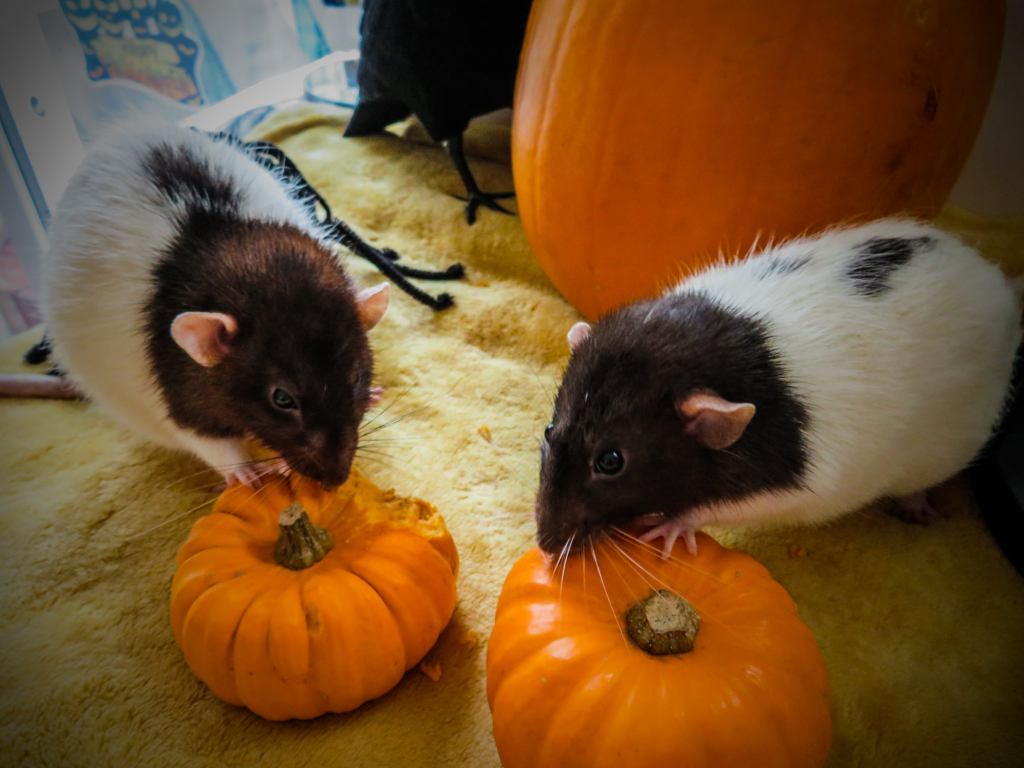
I first got rats as pets when I was 17, I was a psychology student and learning all about medical research studies involving rats as participants, sometimes experiments that killed them or put them through stress and suffering.  All to better understand our own brains and the medical treatments that would be beneficial for us.  I just fell in love with the species, their intelligence and social nature.  So, I got a pair of rats and 11 years later I still have rats, I’ve not been without them since.  Rats were a pet that I had before I developed M.E and I was worried I’d have to give them up when I got ill.  I have my family to thank for initially allowing me to continue to keep them, they helped with the cleaning out and feeding when I wasn’t well enough.  They still help me when I need it.  Having a bed full of rats would probably freak any normal person out but it was a regular joy for me, letting the rats out to free roam around the bedroom cheered me up and it was a way for me to exercise my pets and enjoy them from bed.  I compare having rats to having tiny dogs, they are extremely sociable and friendly, they are intelligent and each one has their own personality.  They are amazing pets, and I couldn’t imagine my life without rats.  They require a lot of stimulation in their cages and regular cleaning out which was sometimes a struggle for me but over the years I’ve found ways to adapt those things and make them easier for me.  I have a raised cage so I don’t have to bend as much, pull out base trays, a cage with big double doors so it’s completely accessible when adding hammocks and ropes.  In a way, chronic illness has made me think outside the box more, I’ve had to find new ways to do things and inventive ways to make things less strenuous or fatigue inducing. 

Luna was more of a spontaneous adoption; a kitten needing a new home.  I’d had M.E for a couple of years and I wanted a nap buddy, so I arranged to go get her and she’s been my best friend for 5 years now.  It wasn’t an easy experience; she came with a lot of issues I hadn’t anticipated.  She had a negative start to life, she was abused and abandoned, underweight and under socialised.  I’d stupidly hoped for a cuddly and affectionate cat immediately and she was the opposite; very frightened and distrustful of people.  She didn’t like being touched or picked up and was very aggressive to anyone coming into the house who wasn’t me.  It was hard because I relied on my family for support and care when I wasn’t well, and they couldn’t really help me because Luna would just attack them when they came in my space.  I thought about rehoming her but I’m stubborn and she’d already had such a horrible experience with people, I didn’t want to give up on her.  It took about a year to gain her trust, and a few years for her to accept my family being around.  She still won’t interact with strangers and she’s aggressive to anyone ‘new’ coming into my life but, with me she’s the most affectionate and cuddly cat.  She doesn’t leave my side, she’s a shadow that follows me around the house.  That companionship has been so important for me, M.E is so isolating and being housebound is the loneliest experience.  Luna has adapted so well to my illness, she’s so relaxed and cuddly when I’m having a bad day, she’s content to just lie with me in bed and provide company.  I can’t express how important that has been for me, that friendship and constant companionship during my time with M.E.

Lastly is my latest addition; Gizmo.  I’ve dreamed of having my own puppy for years, but my health has fluctuated so much that I’ve never felt confident enough to take on that responsibility.  Dogs need a lot more exercise and attention, and I never felt capable enough.  Then last year I decided that I wanted that experience, I don’t think I’ll ever have children and a dog felt like the next best thing.  Living with my parents, I knew I’d have that extra support if I needed it and I wanted a companion for when I’m able to take short walks and get outside.  So, I put my name down on a rescue puppy list and got a call to say there was a 16-week-old puppy, who’d been smuggled from Russia in a lorry, treated terribly and needing a patient, loving home.  I couldn’t refuse, I’m a rescuer, I can’t turn down an opportunity to ‘fix’ or ‘make something better’.  A year later and I can’t remember life without Gizmo.  I won’t lie, it was hard.  My health initially got worse with the extra activity and attention I was putting into a puppy.  I underestimated the effects of training and entertaining a dog, it took a lot of my energy.  But the thing I love about animals the most is that they adapt, and Gizmo has adapted so quickly to my routine.  He’s learned that I need to sleep in the day, and he’s made that his own nap time too, when I’m low energy he brings his toys on the bed to play with, he has just attuned himself to my fluctuating M.E and I think that’s amazing for a puppy to do.

The main thing my pets provide is unconditional love.  As someone with a chronic illness and an ‘invisible illness’, it’s common to receive a lot of judgement and unkind words.  People can be cruel and unthinking; animals aren’t like this.  I feel like my pets accept my illness, they accept how my life is and where my limits are and don’t love me any less for it.  Pets certainly make my life with chronic and mental illness more bearable. 

Self-care and body image with M.E or Chronic Illness

Self-care and body image with M.E or Chronic Illness

Positive body image is something a lot of people with chronic illness struggle with.  When your body is physically unwell it’s hard to feel positive about it.  With chronic illnesses like M.E, it’s easy to feel negatively about your body because physical and mental symptoms limit your life and make every day a fight.  A lot of medication given for M.E symptoms causes weight gain and an increase in appetite which doesn’t help when you can’t exercise without causing a serious relapse of symptoms and post-exertional malaise.  Then there’s the other side, where fatigue makes you unable to put effort into proper meal prep and there are days where the fatigue is so bad you just skip meals, leading to weight loss.  It’s hard to feel good about your self and your body when you deal with these things.

I’ve struggled with body image for a long time, but chronic illness has really brought it to the forefront of my mind.  My weight is a major factor in this struggle, I’ve never been slim, in my late teens I was a size 12-14 and I was always curvier than a lot of my friends.  Since developing M.E I’ve put on weight, mostly due to medication and a lack of mobility. I’ve lost weight, then put it back on again.  Since coming off medication I’ve lost a bit of weight, I’m now a size 18.  Ideally, I’d be happy at a 16 but for now my weight is stable.  Along with this, a number of other M.E symptoms affect me confidence; hyperhidrosis, loss of muscle tone, very pale and thin skin because of a lack of vitamin D etc.  I also have lipoedema in my legs.  All of this causes a lot of self-esteem issues and a very negative body image.  I find it hard to look in the mirror some days and the impact of that on my mental health is overwhelming.  It’s at a point where my family comment on not having any pictures of me because I hate having my photo taken and I avoid cameras.  I graduated last year, and I still haven’t taken a photo with my degree because I can’t stand the idea of looking at myself and being disgusted in what should be a positive and happy photo memento. 

I’ve noticed over the past couple of years this negative body image has affected the way I treat my physical body.  I lost my enjoyment of make-up, stopped using hair straighteners, stopped buying all the nice bath bombs and lotions that I love.  I’ve opted for buying bland and loose clothing which is comfortable when I’m having bad and fatigue days but doesn’t look great.  I see items of clothing I really like but avoid them because I don’t think they’ll look good on me.  It’s like, mentally, I don’t want to treat my body in a nice way because I feel so negatively about it and because my confidence is so non-existent.  It’s a very damaging experience and I’ve become concerned with the amount of influence it has over my life.  Over the past 6 months I’ve tried to bring back the little self-care acts that I’ve been ignoring, and I forgot how the simplest things can make you feel good and refreshed.  So, I thought I’d make a list of some small self-care acts which have made me feel good again.

  1. Face Masks: I’m conscious of my skin and looking after it so I recently bought myself a whole pack of different peel-off face masks and I’ve just been doing one every week.  I just set half an hour aside one night before bed and apply a face mask.  It’s really helped me bring my skin back to a healthy state, it takes all the dirt out of my pores and just makes my face feel refreshed and completely clean. 
  2. Bubble baths and bath bombs:  I used to be obsessed with bubble bath and bath bombs.  Every birthday and Christmas people buy me special bath bombs to add to my collection. A shower is perfect when you’re fatigued and just want a quick wash.  A bubble bath is perfect for moments when you just want to de-stress though, when you just want to pamper your self and take some time out for yourself.  So, if you are lucky enough to have a bathtub, it’s worth buying some bath bombs and some bath oil, and just setting aside that time to just focus on yourself and relaxation.
  3. Buy some new make-up to try: I really miss the days where I’d spend hours picking out make-up and applying it before going out.  I’m lucky enough to have a sister who does Avon and I’m always buying new makeup and then putting it in a drawer to never be used or seen again!  But when I do wear makeup, I just feel so much more myself and there is a boost of confidence that comes from changing the way you look.  Covering up all that tired skin and dark circles under the eyes.  It makes me feel a lot more like a woman and it just makes me more confidence in facing people, almost like armour. 
  4. Nail Polish: I’m so jealous of any person who can grow their nails to a good length.  My anxiety makes me an obsessive nail biter.  My nails are always down to the skin and frayed.  But I love nail polish.  I have a completely crazy amount of nail polish colours and they just make me happy.  When I’m having a bad day, just painting my nails a fun colour makes me happy.  I might have extremely short nails, but it doesn’t stop me painting them crazy colours, even if no one else sees them.  I do it for me, to boost my own mood and have that moment where I’m just focussing on myself and a part of my body which I can make look pretty.
  5. Take time off from technology:  When I’m stuck in bed, I have a tendency to just swipe through social media and the internet.  It’s not always a good thing, I’ll see friends updating their photos and social media, out having fun, having wild nights out and getting lunch with friends. Meanwhile I’m too unwell to get out of bed and have a wash, it just crushes my mood when I’m already physically not feeling great.  So, I think a simple self-care act you can take is just ignoring your phone, iPad or computer for a set period of time.  Just switch of social media and the internet for an hour or longer.
  6. Get a haircut:  I went 2 years without getting my hair cut once.  As a woman with thick, wavy hair, it was a nightmare.  I was just not physically well enough to go out and get my hair done like normal people, sitting for a long period of time was painful and I suffer with very painful skin (allodynia) so the brushing, drying and straightening really hurt my scalp.  So, I just avoided getting it cut. In the end my Mum asked a mobile hairdresser to come to the house and I’ve been having it done ever since.  It’s a great feeling just getting your hair cut, I don’t have anything fancy done, just a trim and thin out but I always feels so much better after.  Mobile hairdressers are great for people with chronic illness because they allow you to have your hair cut at home, where you are comfortable.  It involves a lot less energy and I’m not fatigued by it like I was when I had to go out and interact with people in a salon.  
  7. Get outside: Fresh air doesn’t fix everything but it does boost your mood. M.E leaves a lot of people housebound, I spend the majority of my days at home. But just getting outside for 10-20 minutes and sitting in the garden or taking a 10 minute walk round my village makes me feel much less stagnant. Nature is free and people don’t pay attention to it enough or the ways it can improve mood and impact on people living with mental or chronic illness.

These are just a few things I do to make myself feel good and more positive about myself. The main thing about self-care is remembering to do it for you.  At first, I felt silly doing my nails and putting on make-up just to wander around the house where no one could see, it felt pointless.  Self-care isn’t about pleasing other people, it’s sad that a lot of people feel like they must look or be a certain way, just to please other people.  Do things because they make you feel good and because you care about your body, however broken and dysfunctional it may feel it times.

Me on a self-care day 🙂
The Big Garden Birdwatch and Nature’s effect on Mental and Chronic Health Conditions

The Big Garden Birdwatch and Nature’s effect on Mental and Chronic Health Conditions

This weekend was the Big Garden Birdwatch and it’s something I really enjoy taking part in, as a hobby photographer and as a person with chronic illness.  M.E leaves me housebound a lot of the time and being able to keep that contact with nature is a big mood lifter for me. 

Before I developed M.E I loved walking, there was no limit to how far I could walk or how long I could stay out wandering around fields and forests.  It’s one of the things I miss the most, that complete freedom to walk wherever and for however long I wanted.  I especially enjoyed discovering nature; wildlife and plant life, it was refreshing and as an introverted person, I enjoyed that relationship with nature and the outside.  I lost that connection when I developed M.E.  Walking became something that triggered an overwhelming fatigue, pain and post-exertional malaise.  I’d never felt more unfit, struggling to cover any distance without pain or breathlessness.  Instead of feeling uplifted and refreshed from walking; I felt physically unwell and unhappy.  With that, I lost my love of nature, I lost that enjoyment at seeing wildlife and discovering wild, hidden places. 

Photography changed that for me.  80% of my pictures are taken from my home or garden.  It’s also rekindled my love of walking; despite the limits I still face.  It’s taken the focus off the pain and fatigue when I walk and refocussed it on making the most of being outdoors and capturing that feeling for days I can’t manage to get out for a walk.  When I’m out with my camera, I still experience that breathlessness and pain but now it’s less about forcing myself to walk a certain distance, pushing myself too far so I don’t feel lazy.  It’s now about making the most of being outside for even a short time, taking pictures makes me stop more often, I can take a rest and capture photos of nature around me, then walk a short distance and repeat.  M.E has made me appreciate small joys more, just being outdoors in the country for half an hour gives me a great sense of achievement and happiness.  I accept that I can’t walk without limitations and there will always be that post-exertional payback later but that boost to my mental health and wellbeing is worth it.

Of course, there are many days I don’t have the energy or strength to go out and walk for a bit.  Being housebound with chronic illness is often confused with being antisocial or lazy and I find those judgements to be quite hurtful.  It’s a very isolating experience and something that only other chronic illness sufferers can understand.  It’s so easy for people to say “maybe if you just got out more, you’d feel better” or “you need to walk and exercise outside more”; but those people have no understanding of M.E and the physical repercussions of pushing the body to be active when it’s already struggling. 

One of the reasons I love The Big Garden Birdwatch is because it encourages people to take an hour and just look out and see what nature is just outside the window.  As a person with chronic illness and someone who is stuck indoors a lot; it brings the outside, indoors for a bit.  It makes you appreciate how much can be seen just from a window, how much nature and wildlife is around us every day.  I take many of my bird photographs from my living room; I can be resting on the couch and still enjoy the wildlife and outdoors through my camera.  Once those photos are taken, I can then keep those snapshots and when I’m feeling down and exhausted; remind myself of the wildlife and nature that exists outside, and it keeps my hopes up.  With every picture I take, I feel a connection to nature again.  It’s encouraged me to share my photos more, to give others in similar situations to myself a brief look at nature, to give those who are housebound a reminder of the outdoors.  And by sharing photos of wildlife, I’ve taken from my own window, I feel like I can remind those who are housebound that there are ways to connect with nature despite chronic illness barriers.  Yes, M.E forces me to be housebound much of the time but it’s not going to stop me enjoying the outdoors and trying to find ways to remain connected to the outside world. 

With the Big Garden Birdwatch taking place this weekend, I though it would be a good thing to share some of my own bird photographs.  To highlight that being housebound doesn’t mean being isolated from nature and the outdoors, to encourage those with chronic illness to take an hour and see what lives just outside.  I hope that my photographs show how beautiful nature is and how accessible it is.  Being housebound with chronic illness doesn’t mean we have to cut ourselves off from what’s outdoors.  Realising this has definitely improved my outlook and mental health and with every photo I capture, I boost my mood and suppress that isolation I feel being stuck inside a lot.